The label ‘High Renaissance’ is particularly attached to the short period of highly celebrated artistic production that began towards the end of the 15th century in Florence and further developed in Rome in the first part of the 16th. The label is also applied to art in Venice in the same years, but painting there continued to be outstanding for many more decades. Meanwhile, the art of Northern Europe was going its own way, full of interest, based on its own Renaissance heritage.

The High Renaissance in Florence is generally regarded as beginning with paintings by Leonardo da Vinci. Virgin and Child with St Anne (left, 1501–19) is a product of the final years of his career. It exemplifies his mastery of light and shade, with subtle blending and softening of lines and contours. The figures with their artificial poses are tightly linked to make one unified, living, moving mass.
The Doni Tondo (right, c.1506) by the much younger Michelangelo, betrays his training as a sculptor and his study of works from classical antiquity, then just emerging from excavations of Roman villas. The composition is highly inventive, poses seem strained, while colours seem unnaturally bright. The main characters interact in an intense and intimate way to make a tender depiction of family relationships.


The High Renaissance in Venice was initiated by Giovanni Bellini, whose Madonna of the Meadow, (left, c.1500) comes from the final phase of his life. Mary's blue and rose garments thrust her figure forward from the greys and tans of the view behind her of the foothills of the Alps.
Two of Bellini’s pupils, Giorgione and Titian share the credit for Pastoral Concert (right, c.1510). Two young men, one looking like a countryman, the other like a visitor from the city, are in conversation with each other. More prominent are the two women, whose nudity suggests that we interpret them as imagined, as muses inspiring the men but invisible to them.


The lime-wood sculpture on the left depicting Last Supper (1501-05) is by the German sculptor, Tilman Riemenschneider. It’s a simple presentation of the story without the formality or grandeur of Italian art. The lack of colour throws the emphasis onto light and shade animating the uneven folds of the draperies.
Melencolia (right, 1514) is a masterpiece engraving by Albrecht Durer, the leading German artist of the time. A winged figure is resting her head on her hand in a reflective pose, seemingly weighed down by thoughts, dejected and disheartened. She’s a personification of Melancholy, one of the four humours thought to control human personality and behaviour. The many intriguing details inform an interpretation as a psychological portrait of a creative artist.


These two paintings by Raphael indicate the roles of successive Popes who funded the High Renaissance in Rome. The Sistine Madonna (left, 1513) was commissioned by Julius II - the figure on the left is his likeness but represents his late uncle, Pope Sixtus IV. The trompe l'oeil device of parted curtains reveals a vision of the Virgin Mary walking on clouds and coming towards us.
The portrait on the right (c.1517) is of Pope Leo X with two Cardinals, members of his family who were benefitting from the nepotism common in the period. The objects on the table refer to Leo’s interest in the arts - he’s alleged to have said "Since God has given us the papacy, let us enjoy it".


Michelangelo's frescoes in the Sistine Chapel demonstrate the contrast between his High Renaissance style and that of 30 years later. In the Creation of Adam (left, c.1511), the image of God is unprecedentedly vivid. An invisible spark of electricity can be imagined as passing from one finger to the other, endowing Adam with life and strength.
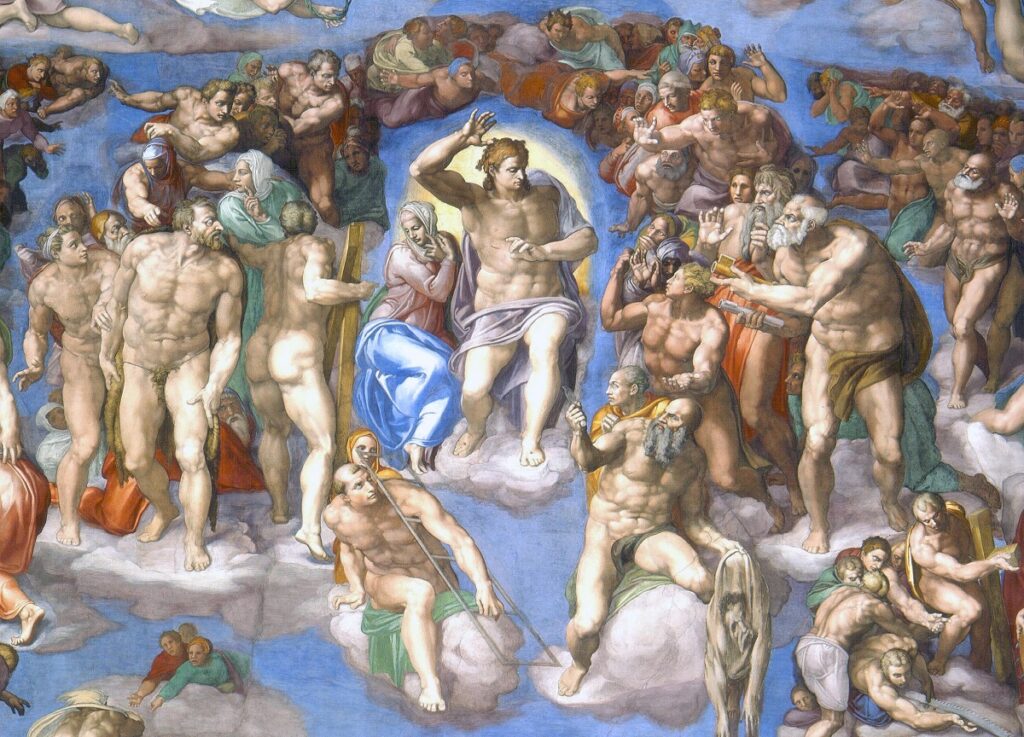
In the huge Last Judgement (right, 1541), figures around the powerful figure of Christ are arranged as if in a seething whirlpool. The strong agitated composition, indeterminate space, tortured poses and exaggerated musculature make the work an example of the style known as Mannerism.

These two paintings demonstrate Mannerist qualities in reactions to the harmony, proportion and naturalism of High Renaissance art. Pontormo’s Joseph with Jacob in Egypt (left, c.1518) has an unnatural approach to space, elongated figures and a spiralling composition.
In Parmiginino’s Madonna of the Long Neck (right, 1535), the Virgin Mary’s elongated body, mighty spread legs and impossibly long neck are of hardly human proportions. We can’t see what she’s sitting on – whatever it is, she almost seems to be slipping off it. The infant Jesus lies precariously on Mary's lap as if about to fall at any moment. The irrationality of such compositions appealed to sophisticated patrons wanting art that was new and different.


Michelangelo’s sculpture Day (left, c.1534) is one of the allegorical figures in the funereal Medici Chapel in Florence. Its kind of elegance is achieved by the distortion of reality for expressive effect - the pose would have been impossibly uncomfortable for any live model.
Cellini’s Salt-cellar (right, c.1543) is a celebrated example of goldsmiths' work. Presiding over receptacles for salt and pepper are figures of classical gods, here reduced to a miniature scale as table ornaments for a royal dinner table - clever, extravagant and entertaining. The intertwining of the forms is typical of Italian Mannerism, as are the rich materials and superb craftsmanship.


The High Renaissance in Rome ended when in 1527 the city was sacked by rebellious German troops, but art in Venice went from strength to strength. Titian’s Bacchus and Ariadne (left, 1523) depicts the god of wine, falling instantly in love with the princess who had been abandoned by her previous lover.
The artist’s brushwork is much freer in The Rape of Europa (right, 1562), telling the story of the princess Europa being abducted by the god Jupiter disguised as a bull. Bold marks with a loaded brush describe the foreground action, while remote forms are thinly painted and lose substance. The impressionistic style helps to evoke the mood of the subject-matter.


One of the most interesting paintings of the Northern Renaissance is The Ambassadors (left, 1533) by Holbein. Information about the two men portrayed is conveyed by the many books and instruments depicted in the composition and suggesting their concerns about the religious differences that were creating
turmoil in Europe at the time.
Van Heemskerck’s Self-portrait
with the Colosseum (right, 1553) records an extended stay in Italy by this Dutch painter. Exposure at first hand to Italy's artistic treasures, ancient and modern, was a means of enriching one’s visual repertoire and boosting one’s reputation at home, where demand for artworks influenced by Italianate fashions was growing.
