Qualities associated with Renaissance artworks are balance, harmony, coherent perspective, realistic lighting and idealised human forms. The later 1500s saw many deviations from these norms, but it was around the turn of the century that more far-reaching developments appeared and were later labelled as ‘Baroque’. Such generalisations have their use, but each individual artwork is different, influenced by the particular circumstances of its creation. The art of Northern Europe was closer to ordinary everyday life than that of Italy,

The ostensible subject of this painting by the Dutch artist Pieter Aertsen is a market trader’s display of an array of foods, mostly life-size. But in the background is the glimpse of a biblical scene, the Virgin Mary on her journey to Egypt - an example of so-called compositional inversion.
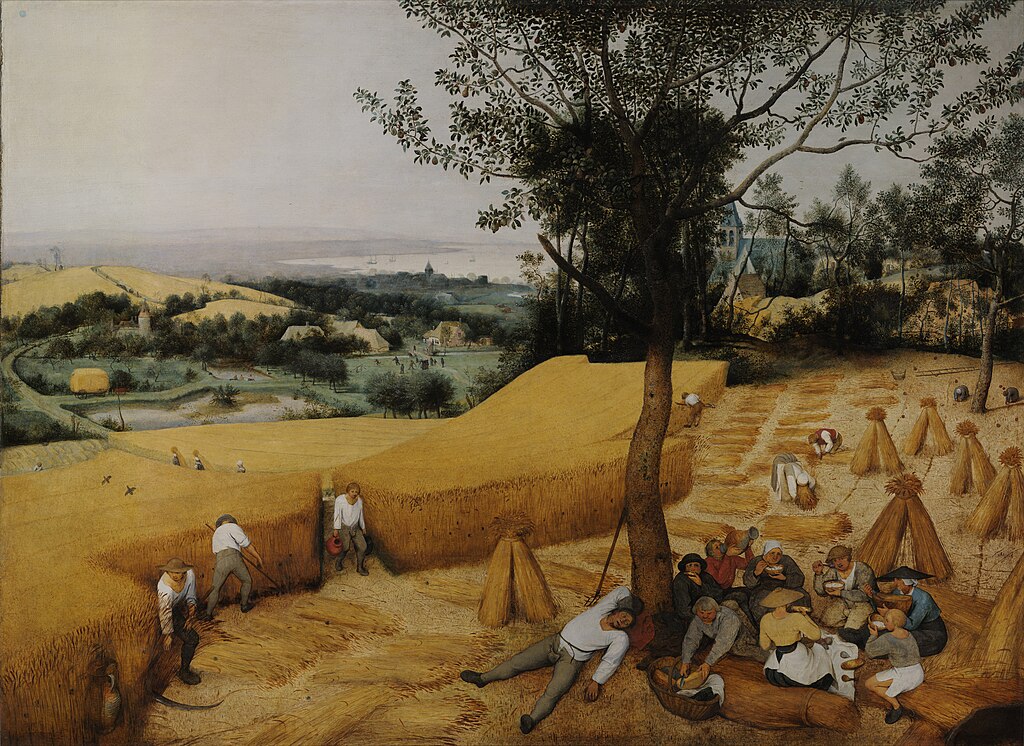
The 1568 landscape painting by the Flemish Pieter Bruegel the Elder is one of a set representing the seasons of the year. In its observations of everyday life, farm workers are valued as human beings, living and working close to the soil, an integral part of the environment.

This painting by the Venetian artist Jacopo Tintoretto shows a group of men searching an Alexandrian catacomb with the intention of stealing a valued relic to bring it to Venice. The composition is dramatic with an exaggerated perspective, while exploiting light and shadow to create a sense of tension.
This representation of a visionary experience is by the Greek artist known as El Greco, who trained in Italy and worked in Spain. It has elongated figures, a dynamic and unbalanced composition, and clashing colours. Each of these two paintings deviates from Renaissance norms in a different way, but their sophisticated compositions and their artificiality place them within the movement known as Mannerism.


A story from the history of ancient Greece is represented by the Venetian artist Paolo Veronese as taking place in the glamorous surroundings of his own city. We’re shown the family of the defeated Persian king pleading for mercy from the victorious Greeks. Everything is idealised.
This depiction of a biblical story by the Italian artist Caravaggio was ground-breaking both in its low-class tavern setting and in its dramatic use of light and shade. The gritty realism and the presence of the figures draw the viewer into the scene. The innovative approach was hugely influential, introducing qualities that would come to characterise the Baroque.


Here’s a comparison between a 16th century portrait and a 17th century one. The North Italian artist Giovanni Moroni captures a fleeting moment in the life of a craftsman engaged in manual work. He’s obviously been successful and is represented with levels of dignity and psychological depth previously reserved for elite subjects.
The man in a flamboyant, embroidered costume depicted by the Dutch artist Frans Hals is unidentified but probably a prosperous merchant who liked dressing up. Notice how loose, expressive brushstrokes contribute to the painting's liveliness. It’s a vivid characterization with a sense of immediacy, making us feel that his smile is a response to us as we look at him.

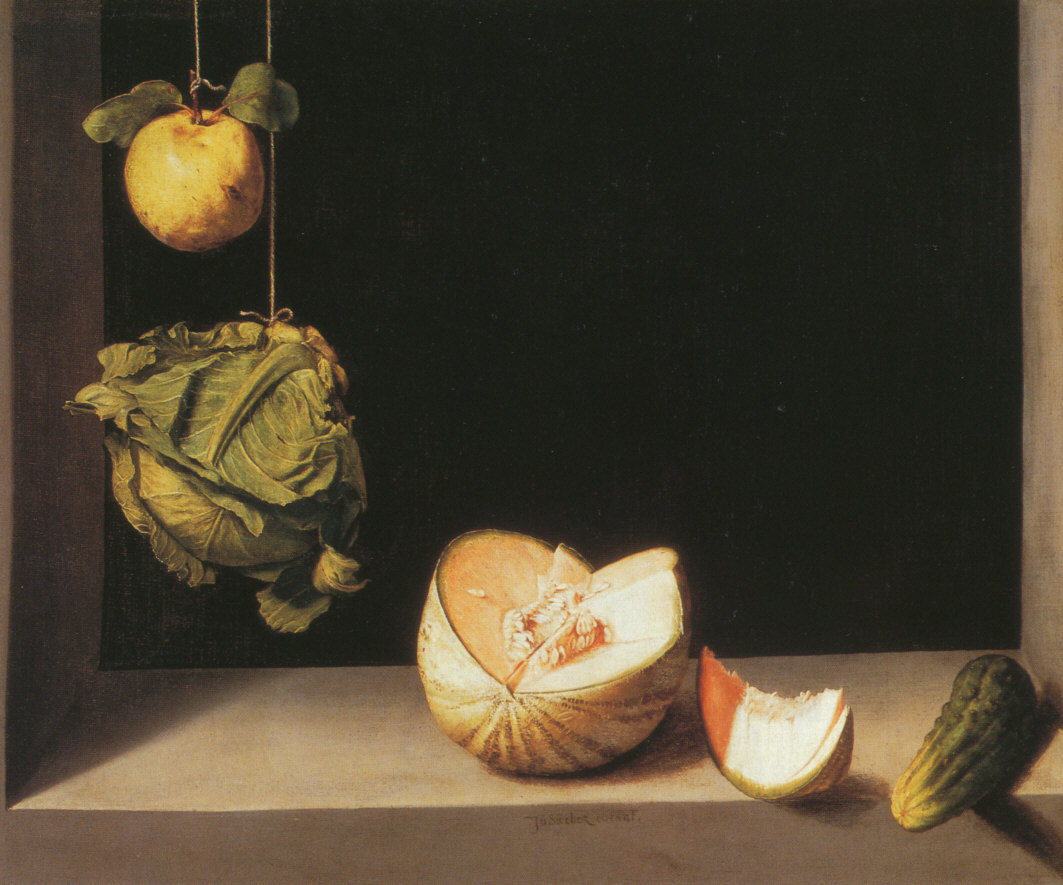
The artist Juan Sanchez Cotán was a pioneer of Spanish still life painting. Here, an arrangement of simple foodstuffs is framed in the opening of a window, the objects made to seem real by a skilful use of light and shade.
The Dutch artist Ambrosius Bosschaert was a pioneer of flower painting. Here, individual flowers are depicted with scientific precision as if a group portrait, evenly lit and maintaining the visual integrity of each, irrespective of time of year when in bloom. Artists were competing with each other to sell their work and the strategy of these two was to earn a reputation in a particular speciality.


Adam Elsheimer, a German working in Rome, was a highly influential artist who painted small-scale works on copper, combining precision of technique with inventive explorations of landscapes. This one tells the story of the Holy Family journeying to escape persecution and, unusually, giving it a night-time setting.
Best known for depictions of scenes in artificial light was the French artist Georges de la Tour. Here he imagines a workshop in Nazareth with the young Jesus holding a candle that provides the illumination. The two paintings illustrate a trend away from scenes uniformly lit towards different lighting conditions


This large painting, one of a set by Peter Paul Rubens, shows King Henry IV of France supposedly captivated by a portrait of his intended wife - the marriage had actually been negotiated for political and financial reasons. This rich mix of mythology and symbolism in a dramatic Baroque style was art as propaganda .
By contrast, the paintings of Nicolas Poussin are noted for their ordered compositions as well as for effective story-telling. He was French with French patrons, but worked in Rome with its classical influences. Here, village girl Rebecca is being addressed by a servant sent across the desert to find a wife for the son of his master Abraham, He was to choose the first young woman to offer him water.


Portraits by Diego Velazquez in Spain and by the Flemish Anthony Van Dyck working in England reflect the increasing importance in the 17th century of kings and their associates as patrons of art. Behind the apparent casualness with which each monarch is depicted are natural looks of authority.
Hunting served as a powerful metaphor for kingship by symbolizing a ruler's strength, skill, and control over his domain. Philip seems more sombre and introspective, conveying a sense of the burdens of leadership, while Charles exudes an air of elegance, confidence, and relaxed grace. Velazquez and Van Dyck used their positions as court artists to develop distinctive styles that reflected the tastes and expectations of their respective monarchs.


This family chapel in Santa Maria della Vittoria in Rome was made by Gian Lorenzo Bernini to look like an intimate little theatre in an exciting fusion of architecture and sculpture. Corona family members in balconies are observing the scene of Saint Teresa in a state of religious ecstasy during a vision of an angel thrusting an arrow into her heart.
In this enigmatic scene in a royal palace, Velazquez depicts himself at work on a large canvas, presumably a portrait. It could be of the little princess, who’s attended by her maids of honour or of the King and Queen reflected in the mirror at the back of the room or even of ourselves the viewers of the painting ? These two works are powerful examples of Baroque art, each offering a unique take on what art can do.
